Systems for participation, feedback, and distributed experience
I’m currently out of Los Angeles and staying in Washington D.C. for two weeks. I’m spending time in the Nam June Paik Archive Collection at the Smithsonian American Art Museum (SAAM), immersing myself in Paik’s life and work. The contents of his studio were relocated here after he died in 2006 and they have been carefully indexed. I’m working through these materials with a focus on his writing, correspondence, sketchbooks, and project files.
I plan to write more about the experience and share materials in the future. For now, I’ve assembled a short list of artworks that have my current attention. Among his many contributions, Paik created a wide-ranging body of work that helps lay the groundwork for what Lauren Lee McCarthy and I are defining as “social software”—systems that organize behavior, coordinate people, or structure interaction.
If you’re new to his work, Nam June Paik was one of the most inventive artists of the last century. His practice consistently organized participation between people, machines, and signals. Across decades and through performance, sound, video, and broadcast television, his work established inventive feedback systems and distributed experience at local and global scales. The shortest biography is that he was born in Korea in 1932, lived in Japanese occupied Korea during the WWII era, moved to West Germany in 1957 to study music, and then moved to New York City in 1964 to later become the “George Washington of Video Art.” He was an inventive, radical, always-working artist with tremendous energy and ambition.
—Casey Reas, 22 March 2026
Random Access (1963/2000)
I’m starting with this artwork because it’s the earliest, but also my favorite. The foundation of the piece is a deconstructed magnetic tape system—tape and player pulled apart. It’s called Random Access, but the whole premise of magnetic tape is linearity. You rewind, press play, and the motor pulls the tape across the playback head at a fixed speed. Sound unfolds in sequence, one moment after another. Paik broke this system wide open. He pulled the tape off the reel, cut it into pieces of varying length, and stretched them across the wall. The work doesn’t play itself. He handed the playback head to the audience. I’ve never seen this installed, so I haven’t had the experience of activating it, but I feel like I don’t need to. It’s a strong conceptual gesture. It reverses the situation of listening to music as it’s typically presented. Here, the music must be discovered and performed by picking a tape fragment and moving the playback head across its surface. The audience selects which sounds to play, for how long, and at what speed.
Robot K-456 (1964)
I can only imagine what it must have been like to walk through downtown Manhattan in 1964 and encounter Paik’s Robot K-456 moving along the sidewalk with its idiosyncratic gait. This was a ramshackle robot that seemed barely able to keep itself upright, far removed from the world-conquering machines of science fiction of that era, like Gort in The Day the Earth Stood Still. In film documentation, Nam June Paik can be seen crouching near a building, remotely controlling the robot. The robot addressed the public through recordings of the recently assassinated president, John F. Kennedy. The idea was to engage with people on the street, to create a situation for interaction. It was absurd and delightful. As Paik said, “My work looks whimsical, but it has [a] profound background. I make technology ridiculous.”
LINK ↗
Magnet TV (1965)
TV’s, the old kind, were cubic boxes full of analog electronics. The point of a TV from this era was to have a clear picture, free from distortion. Paik’s approach to TV was subversive, he gave the viewer the tools to destroy the image through placing a large magnet on top and encouraging them to move it around to distort the televisual in different ways. Like Random Access, this artwork is activated by the audience. The TV is transformed from a one-way medium into a responsive image field. This way of engaging with art in galleries and museums is still uncommon now, but it was even more suspicious when he showed it at Galeria Bonino 1965. John Canady of the New York Times wrote, “The TV sets can be ‘played’ as one would play a musical instrument if music were light—although possibly Mr. Paik has not yet quite brought his electronic art to a level comparable to any music except John Cage's.”
LINK ↗
Paik/Abe Video Synthesizer (1969–1971)
What is a “video synthesizer,” you may ask? It’s a box of analog electronics that either generates or transforms video images in real time. The Paik/Abe instrument is of the transformative variety. It takes a video signal in, alters it by routing it through custom electronic circuits, and sends the modified signal back out for display. The curator George Fifield remarked that it “contaminated the video signal,” a phrase that captures both its effect and the frustration it caused among broadcast engineers who sought stability and fidelity. The machine emerged out of friction. While working as an artist-in-residence at WGBH in Boston, Paik pushed against the constraints of institutional broadcast systems. He wanted more independence and control over the signal itself. He secured support to travel to Japan and collaborate with the engineer Shuya Abe to build a new kind of instrument. The Paik/Abe Video Synthesizer became central to his work moving forward. Paik and Abe continued to refine its design, while Paik shared it through workshops and mentorship. Paik’s ideas for the synthesizer extended to mass adoption. Years before, he wrote about his vision for “the development of an adapter with dozens of possibilities which anyone could use in his own home, using his increased leisure to transform his TV set from a passive pastime to active creation.”
LINK ↗
Global Groove (1973)
“This is a glimpse of a video landscape of tomorrow when you will be able to switch to any TV station on the earth. And TV guides will be as fat as the Manhattan telephone book.”
In the early 1970s, Paik expanded his practice in new directions. Moving away from his earlier absurdist performances, he worked more frequently with video. Through a collaboration with WNET in New York, he was able to produce and broadcast his work to a wider audience. After the brief introduction by the narrator (quote above), the video opens with the uptempo medley “Devil with a Blue Dress On/Good Golly Miss Molly” as two dancers move to the music, their bodies animated by vibrant ripple distortions. The Paik/Abe Video Synthesizer is used to great effect throughout the half-hour program. The work brings together earlier projects while articulating a new vision for broadcast video and Paik’s evolving practice. Paik’s collaborator Charlotte Moorman appears performing their Cello works. Footage of Magnet TV, distorting images of Richard Nixon, is woven into the sequence. The result is a dense layering of performance, signal manipulation, and cultural reference. A description from Electronic Arts Intermix captures it well: “Paik subjects this transcultural, intertextual content to an exuberant, stream-of-consciousness onslaught of disruptive editing and technological devices, including audio and video synthesis, colorization, ironic juxtapositions, temporal shifts and layering — a controlled chaos that suggests a hallucinatory romp through the channels of a global TV.” We’ll see this carried further in Good Morning, Mr. Orwell (1984).
LINK ↗
TV Buddha (1974)
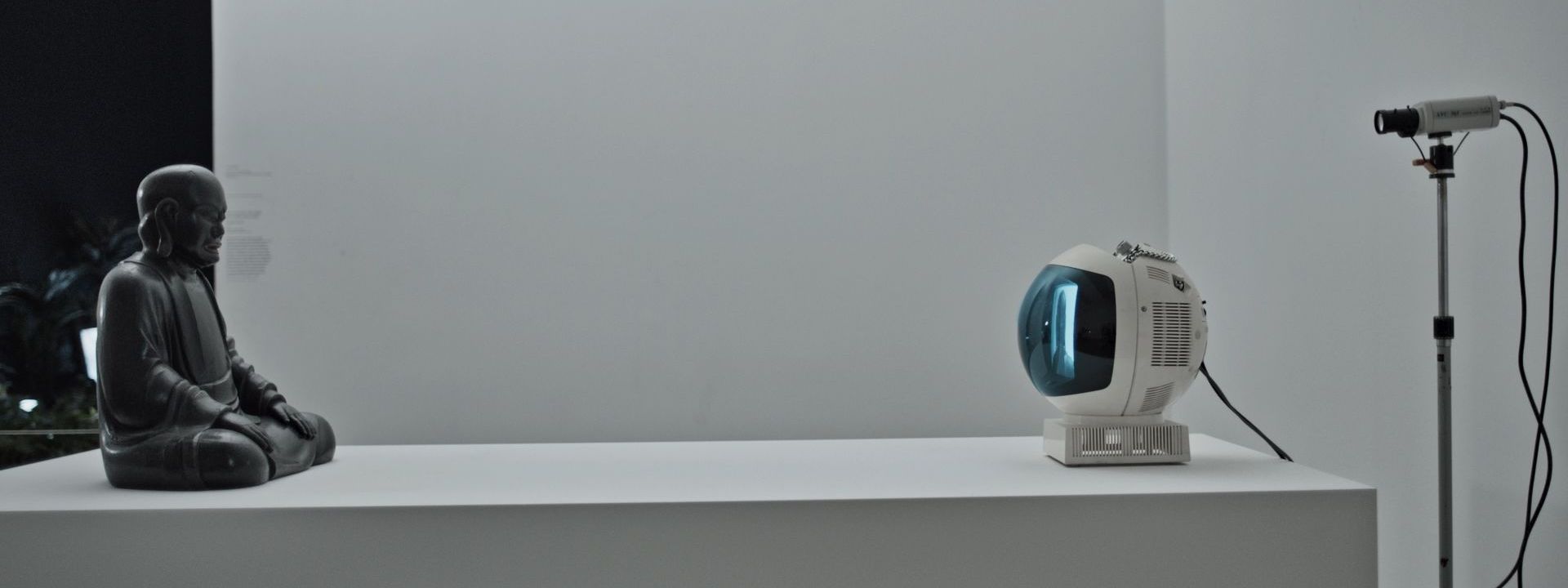
This may be the most iconic work by Nam June Paik. There are many versions, but in each a Buddha sculpture sits before a television, watching a live image of itself. What does it mean? It likely means different things to different people, but it stages a clear collision between spirituality and contemporary technology. I initially hesitated to include it in this list of “social software” works, but it holds. The system is closed, yet relational: camera, monitor, object, and viewer are bound in a continuous feedback loop. It organizes attention and perception as a live circuit. It is a system for contemplating oneself.
LINK ↗
Good Morning, Mr. Orwell (1984)
After the live satellite broadcast ended, Nam June Paik said, “That we failed here and there does not really matter. That is more interesting.” Good Morning, Mr. Orwell was a visionary global event, viewed live by more than 25 million people. It proposed a new dream for what television could be, in opposition to what it had become. Broadcast on New Year’s Day in 1984, Paik aimed to counter the pessimistic vision of George Orwell’s Nineteen Eighty-Four (1949). The program built on the trajectory of Global Groove, bringing together imagery and performances from Asia, the Americas, and Europe to mirror Paik’s own transnational biography. Unlike Global Groove, this work was broadcast live and linked multiple sites in the U.S., France, and Germany in real time. It featured well-known artists such as Laurie Anderson in New York and Sapho in Paris, alongside Paik’s collaborators and heroes, including John Cage, Allen Ginsberg, and Charlotte Moorman. My personal highlight was choreographer and dancer Merce Cunningham’s solo performance, dancing with his own time-delayed satellite video image. This was the first of a trilogy of live television events orchestrated by Paik over the following years.
LINK ↗
Doc